
Why the Chinese Approach to Electrifying Mining Trucks Differs from That of Leading International Players
A 240-ton mining truck consumes approximately 400 kWh of electricity per operational cycle. The question of how to replenish this energy has led the world down three distinct paths—and the path chosen by China is one that few, if any, major international mining companies are currently pursuing.
Strategic Moves by Major Overseas Mining Companies: Two Orders, Two Paths
In 2024, Fortescue signed a deal with Liebherr valued at approximately $2.8 billion for 475 units of equipment—including around 360 autonomous, battery-electric T 264 mining trucks. This marks the largest single order in Liebherr’s 75-year history.
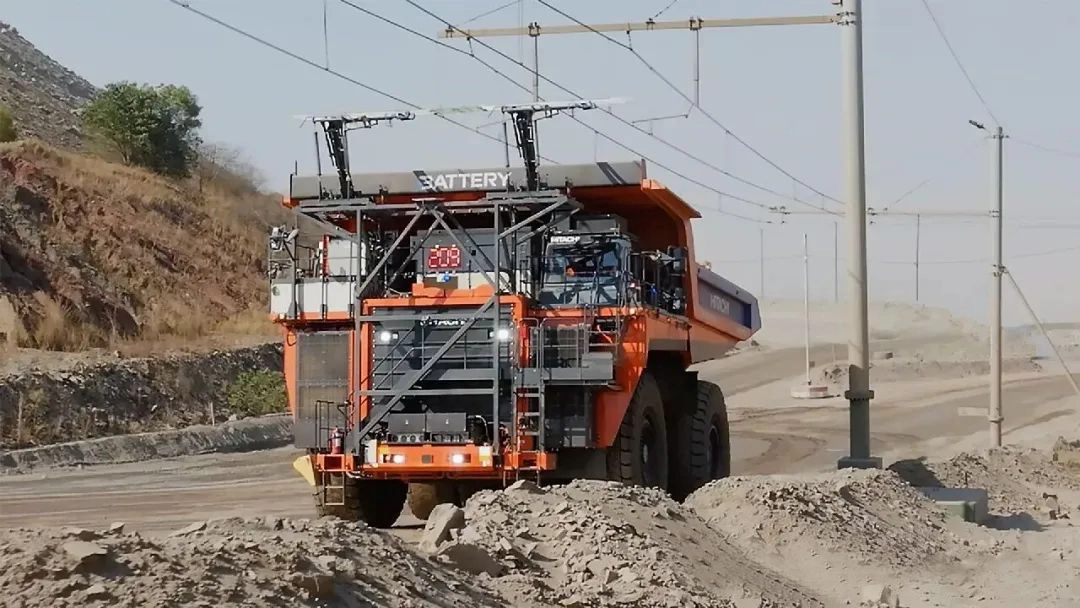
Around the same time, at First Quantum’s Kansanshi copper mine in Zambia, Hitachi retrofitted an EH 4000 AC truck to run on battery power. However, the vehicle does not rely on charging stations; instead, it operates using an overhead catenary system already installed at the mine site.
In China, a project involving the delivery of around a hundred electric mining trucks during the same period utilized the third approach.
Fortescue | Western Australia
Large-scale Battery + Megawatt-scale Ultra-fast Charging
· Approx. 360 battery-electric T 264 haul trucks
· 3.2 MWh battery capacity · 6 MW charging stations
· $2.8 billion – the largest single order in Liebherr’s history
Hitachi × FQM | Zambia
Dynamic Catenary Charging + Battery
· EH 4000 AC retrofitted for battery-electric operation
· Utilizes the mine’s existing overhead catenary infrastructure
· 4,143 km traveled · Over 30,000 tonnes transported
Rio Tinto | Oyu Tolgoi, Mongolia
Battery Swapping (The Chinese Solution)
· 8 × 91-tonne mining trucks · 13 battery packs
· 800 kWh per pack · Battery swap time: <7 minutes
· A two-year trial in collaboration with SPIC Qiyuan and Tongli
All three paths are backed by the most influential players in the industry. Where, then, does the disagreement lie?
I. To begin with, let’s clarify: what exactly makes large, all-electric mining trucks so challenging.
② How much electricity is consumed per cycle?
A complete cycle—comprising loading, hauling a heavy load uphill, unloading, and returning empty—consumes approximately 400 kWh of electricity (net). This figure aligns with the technical targets set out in the “Charge On Innovation Challenge,” an initiative launched jointly by BHP, Rio Tinto, and Vale.
Heavy-load uphill haul (potential energy + rolling resistance): ~450 kWh
Energy recovered during empty-load downhill travel: ~55 kWh
Net consumption per cycle: ~400 kWh
Order-of-magnitude estimate: Based on a 240-ton class truck with a total laden weight of approximately 400 tons and a vertical lift of about 250 meters. Actual figures vary significantly from one mine to another.
Before discussing the route, there are four matters that need to be ironed out first.
① Ultra-large mining trucks are a different breed altogether.
The “electrification of mining trucks” spans two entirely distinct product categories——
90–110 Ton Class
Wide-Body Dump Trucks
The primary segment for Chinese manufacturers
200–400 Ton Class
Rigid-Frame Mining Dump Trucks
The primary equipment used in large-scale copper and iron mines globally
The latter category possesses a feature that many are unaware of: they have long utilized “electric drive” systems. Instead of the diesel engine driving the wheels directly, it powers a generator, which in turn supplies electricity to motors that drive the wheels—a configuration known in the industry as “electric drive” (or diesel-electric transmission).
While this may seem like a mere technical detail, it serves as the foundational premise for everything that follows. Please keep this in mind.
③ That leaves just three questions:
1. How much electricity should the vehicle carry?
2. How should that electricity be replenished?
3. Does the vehicle need to stop in order to be recharged?
Every divergence in strategy across the global industry stems from these three questions. No one is debating whether or not to use electricity.
④ Four terms—no further explanation provided below:
Trolley (Overhead Catenary System): High-voltage DC overhead lines are installed above the main ramps in mining areas; vehicles draw power via a roof-mounted pantograph. Adapted from railway electrification, this technology has been used in mining for decades.
Dynamic Energy Replenishment: Vehicles draw power from the overhead lines while in motion, with any surplus energy used to charge the onboard battery.
Battery Swapping: Once the battery is depleted, the entire pack is replaced; the removed batteries are then charged at a centralized station.
Ultra-fast Charging: Megawatt-class stationary charging stations where vehicles stop to recharge.
The challenge with electrification has never been “whether electricity can be used,” but rather “how that electricity is replenished.”
II. China’s Solution: Battery Swapping
China has put forward a highly consistent solution: battery swapping. Moreover, this is no longer in the experimental phase; it has reached the stage of large-scale implementation. Below are three representative projects showcasing China’s battery-swapping approach:
Rio Tinto | Oyu Tolgoi Copper Mine, Mongolia
SPIC Qiyuan × Tongli Heavy Industries
The project involves 8 units of 91-ton class mining trucks, 13 battery packs (800 kWh each), and a supporting battery-swapping station—with each swap taking less than 7 minutes. Spanning a two-year term, the equipment is deployed for operations such as tailings dam management and topsoil handling.
→ This marks the first time a Chinese technical approach has been formally validated by a Tier 1 mining company.
Huaneng Yimin Open-Pit Coal Mine
Huaneng × XCMG × Huawei × State Grid
The world’s first autonomous, electric mining truck haulage system operating at a scale of 100+ units.
→ This is not a case of a single vehicle manufacturer selling trucks; rather, it is a joint initiative involving four parties: the mine operator, the equipment manufacturer, the telecommunications provider, and the power grid operator.
Baoqing Chaoyang Open-Pit Coal Mine
2025
The simultaneous acquisition of 100 high-tonnage, all-electric mining trucks sets a new record for the scale of a single procurement in Northeast China.
Why battery swapping?
The reason lies not in a technical preference, but in specific endowments and use cases. China’s comparative advantages include lower battery costs, a mature supply chain for battery-swapping stations, and the robust supporting capabilities of state-owned energy enterprises—covering green energy, energy storage, and station operations—all of which are readily available in China. Furthermore, domestic open-pit mines—primarily coal mines—feature short transport distances and relatively gentle gradients, making the economics of battery swapping highly viable.
III. The Answer from Leading Overseas Mining Companies: Almost No One Is Switching to Battery Swapping
BHP × Rio Tinto × Caterpillar
Jimblebar Iron Ore Mine, Western Australia
Two Cat 793 XE battery-electric mining trucks; over 100 cumulative operating hours and more than 200 test cycles completed.
Fortescue × Liebherr
Western Australia
Battery-electric + 6 MW stationary ultra-fast charging; full charge in approximately 30 minutes
Hitachi × First Quantum
Kansanshi Copper Mine, Zambia
Battery-powered haul trucks operated directly on existing overhead lines, covering 4,143 km and transporting over 30,000 tonnes of material.
A review of the electrification projects announced by leading overseas mining companies over the past two years reveals a notable trend: battery swapping is almost never among the options considered.
This is not a matter of who is right or wrong; rather, each party is simply addressing its own unique set of challenges.
IV. Going overseas is not a matter of choosing one path; it is a case of placing bets on two paths simultaneously.
Here is a fact that is easily overlooked: all four leading overseas mining-truck OEMs have made strategic moves in the area of dynamic, on-the-go charging via overhead lines.
Hitachi Construction Machinery × ABB
Proven in the field
Currently the only publicly documented demonstration project involving a battery-catenary system (at the Kansanshi mine), utilizing a high-rate LTO (lithium-titanate) battery technology.
Caterpillar
In Pilot Phase
Cat DET Relocatable Trackway Solution; BHP is the first customer to announce a trial, and Codelco has also confirmed a pilot.
Komatsu
Undergoing testing
Power Agnostic 930E modular platform, being tested at the Boliden Aitik copper mine
Liebherr × ABB
A Strategic Move
A global agreement with ABB incorporates electrification solutions into Liebherr’s product portfolio.
Looking at this table, it is easy to conclude that “the industry has converged toward overhead line installation.” However, such a conclusion is reached too hastily. Three points must be clarified:
⚠ Three Facts That Must Be Clarified
1. The Komatsu unit deployed at Aitik uses a diesel-trolley system, not a battery-trolley system.
This “Power Agnostic” 930E, deployed in April 2025 for a 12-month field trial, is equipped with diesel power supplemented by a trolley assist; battery and hydrogen fuel cell options remain on the roadmap.
2. Liebherr’s largest order is for a purely battery-powered solution—no trolley system involved.
Fortescue’s order for 360 T 264 trucks features 3.2 MWh battery packs and 6 MW charging infrastructure. The largest mining truck order in industry history has, in fact, gone to a non-trolley architecture.
3. Hitachi and Liebherr share the same key technology supplier.
ABB’s eMine Trolley System is covered by global agreements with Hitachi, Hitachi Construction Machinery, and Liebherr. Consequently, the argument that these four independent entities are “converging” on the same solution should be viewed with some skepticism.
So, what is actually converging?
It’s not about the overhead lines; it’s about “platform switchability.“
Komatsu has explicitly named its platform “Power Agnostic”—which, literally, means it is indifferent to the specific energy source. Its modular architecture decouples the powertrain from the core vehicle components, allowing customers to start with conventional diesel and—depending on their specific needs, the maturity of various technologies, and their own decarbonization timelines—gradually transition to battery-electric or hydrogen fuel-cell systems. Caterpillar’s DET (Diesel-Electric/Battery) platform follows the same logic, supporting both diesel-electric and battery-powered mining trucks.
What mining companies are actually purchasing is an option on the uncertainty surrounding energy pathways. They are not betting on a single path; rather, they are buying a ticket that spares them from having to make such a gamble.
V. Why Divergence Occurs: Mine Geometry Dictates Energy-Replenishment Routes
At this point, we can answer the question posed at the beginning. The divergence among these three approaches does not stem from differences in technical sophistication, but rather from the physical characteristics of the mines themselves.
Overhead Catenary Dynamic Charging + Battery
Deep-pit mining haulage / depths exceeding 200 m / fixed main ramp / robust power grid
Typical mining regions: Copper mines in Chile/Peru, the Zambian Copperbelt, Canada, and Northern Europe
Large battery + megawatt-scale supercharging
Multiple mine pits / frequently changing haulage routes / relatively short mine lifespan
Typical mining area: Pilbara iron ore region, Western Australia
Battery Swapping
Suitable for: Small-to-medium tonnage, short-haul transport, gentle slopes, and scenarios with an established battery-swapping ecosystem.
Typical mining sites: Open-pit coal mines in China; various small-to-medium-scale mines overseas.
Let’s use a specific case to illustrate this table—
Why have BHP and Rio Tinto opted for pure battery-electric solutions—rather than overhead catenary systems—at their operations in the Pilbara?
The reason lies in the typical layout of iron ore mines in the Pilbara: they feature multiple pits and dispersed haulage routes, with active mining areas that shift constantly as operations progress. This geometric configuration is inherently ill-suited for fixed infrastructure—a power line installed today might become redundant by next year as the haul ramp falls out of use.
In contrast, copper mines in Chile and Peru follow a different geometric model: deep, open-pit operations where the primary haul ramp can span a vertical drop of hundreds of meters. With mine lifespans often exceeding twenty years, the locations of these ramps remain static for long periods. The same logic applies to the Zambian Copperbelt, as well as certain mines in Canada and Northern Europe.
At such sites, an investment in overhead catenary systems offers a clear, calculable payback period. The choice of energy-replenishment method is not a matter of which technology is more “advanced,” but rather a function of the mine’s specific geometric layout.
VI. A significant portion of the core assets held by leading mining companies falls into the “overhead-line-powered” category.
Approximately 30% of global copper production is concentrated in Chile and Peru. When combined with the Copperbelt in Zambia, as well as operations in Canada and Northern Europe, the geographical layout of these assets—in terms of transport logistics—falls squarely within the optimal range for the implementation of dynamic, overhead-line-based energy replenishment systems.
Furthermore, the necessary overhead infrastructure is already in place at many of these mine sites.
Selected mine sites with trolley-assist systems installed:
· Kansanshi (First Quantum, Zambia)
· Copper Mountain (Canada)
· Boliden Aitik (Sweden; one of the largest open-pit copper mines in Europe)
· ABB has completed its first eMine trolley system installations in South America
What Hitachi has done at Kansanshi essentially leverages existing infrastructure: rather than building new lines, they have converted the vehicles to run on battery power while still utilizing the mine’s pre-existing overhead lines.
The infrastructure at these mines is already in place, and the capital investment has already been made.
VII. What has caused a twenty-year stalemate is not technology, but the cost of migration.
So, the question arises: given that overhead line systems have been used in mines for decades—with proven technology and clear economic benefits—why have they never become the mainstream solution?
The answer lies not in the technology, but in the costs of relocation. Fixed overhead lines present three types of rigid constraints:
1. Rigidity of Infrastructure Layout
Changing a ramp means “sunk” investment.
Mine excavation plans are dynamic; no one can guarantee that a main ramp will remain in the same location ten years later.
2. Rigidity of Budgeting (Crucial)
It falls under mine infrastructure capital expenditure (CAPEX), not equipment procurement.
These two types of expenditure involve different decision-makers, distinct approval hierarchies, and separate evaluation criteria—often extending the timeline by 2–3 years. Purchasing a haul truck is the purview of the equipment department, whereas installing an overhead line system is a matter for the capital projects committee. Even if the operations team recognizes the value, the project must enter an entirely different—and much slower—approval queue. Many proposals fail here, rather than during the technical review phase.
3. Operational Rigidity
Speed limits, inability to overtake on single-lane sections, and power collection stability.
Issues with power collection—exacerbated by conditions like dust, rain, or snow—have long been a source of operational friction for overhead-line-assisted haulage systems.
It’s not that mining companies fail to recognize the value of overhead power lines; rather, they are reluctant to tie up capital in infrastructure that might eventually need to be relocated.
VIII. Carter is tearing down this wall: DET
Only by understanding the section above can one grasp what Carter is doing.
- Relocatable: Featuring a mobile rail system and power conversion modules, the infrastructure offers flexible reconfiguration. It is suitable for both established and new mining sites, and can be relocated or expanded to maximize coverage across the operation.
- Dual Compatibility: Compatible with both diesel-electric and battery-electric haul trucks. This allows mining operators to benefit from the system without needing an immediate, wholesale fleet replacement—significantly lowering the barrier to adoption.
- Broad Adaptability: The pantograph (power collector arm) can be mounted on either side of the vehicle, accommodating a wide range of truck models. Caterpillar has confirmed that all its current large-scale diesel-electric and battery-electric haul truck platforms are compatible with the DET (Dynamic Electric Transport) system.
- Autonomous-Ready: Integrates with the Cat MineStar Command autonomous hauling solution. It also addresses a long-standing operational challenge: the precision of automated pantograph engagement—which is far more accurate than manual operation—is now ensured for autonomous trucks.
Implementation Timeline
September 2024 — Announced at MINExpo; BHP becomes the first customer to commit to a trial.
October 2025 — Codelco confirms a pilot program at its Radomiro Tomic mine, featuring three Cat 798 AC units.
Q2 2026 — Official system launch; projected to reduce emissions by 60–70%.
The significance of DET lies not merely in the addition of a new product to Caterpillar’s portfolio, but in its attempt to extend the applicability of trolley-assist systems—previously limited to long-life, deep-pit mines—to virtually all open-pit mining operations. By eliminating the barriers to adoption, the combination of “trolley-based energy replenishment” and “pure electric drive” shifts from a niche solution to a universal architecture.
It should be noted that DET has not yet been validated at scale; the pilot project at Codelco serves as the first observable data point. There remains a significant gap—filled with various engineering challenges—between a product announcement and a proven, established reality.
IX. The Real Bottom Line: It’s Not About Saving Costs, It’s About Capital Efficiency
This brings us to an unavoidable question: what is this technology actually worth?
Industry marketing typically claims “90% savings in diesel”—ABB, for instance, states that its eMine trolley system can reduce diesel consumption by up to 90%, while Caterpillar projects a 60–70% reduction through its Dynamic Energy Transfer (DET) system.
These figures are accurate, yet they may well be the least significant part of the overall benefit.
Value Hierarchy for Mining Enterprises:
Availability > Capital Efficiency > Operating Costs > Emissions Compliance
An ultra-class mining truck represents an asset value of $5–8 million; its entire economic viability hinges on it remaining “up and running.” Any solution that causes such a vehicle to sit idle carries a cost far greater than any savings gained from reduced fuel consumption.
When recalculated from this perspective, dynamic energy replenishment actually presents two separate accounts.
Account 1 | Availability
Converting charging time back into transport time
- With a net consumption of approximately 400 kWh per cycle, a 3.2 MWh battery (accounting for usable depth of discharge) supports roughly 3 hours of operation.
- Even with a 6 MW ultra-fast charging system, a single charge takes about 30 minutes—not including time spent queuing or maneuvering into position.
- With an overhead catenary system: vehicles draw power directly on uphill sections, feed excess energy into the battery, and recover energy during descents—theoretically eliminating the need for dedicated charging stops.
Loss in availability: 12%–15%
Account II | Payload
Shrinking the Battery, Increasing the Payload
A 3.2 MWh battery pack weighs approximately 21 tons; when installed on a 240-ton-class vehicle, it consumes nearly 9% of the effective payload.
Increasing battery size creates a negative feedback loop: a heavier vehicle requires more energy to climb the same incline, which in turn necessitates an even larger battery.
With an overhead-catenary (trolley) system, the battery only needs to cover flat terrain and provide a safety margin—requiring just 1.0–1.5 MWh—thereby reducing vehicle weight by 15–20 tons.
This results in a 6%–8% recovery in the transport capacity of each vehicle.
As an aside, let’s look at a technical choice that is often misunderstood.
Hitachi’s decision to use LTO (lithium titanate) batteries for the Kansanshi project is frequently interpreted as “opting for a path with lower energy density.” However, when you break down the underlying logic, this choice becomes perfectly logical.
In a catenary-powered (overhead line) architecture, there is no need for a large onboard energy storage capacity. Instead, the system requires the ability to handle frequent, high-power charging and discharging cycles without degradation. While LTO batteries do indeed have lower energy density, their high-rate charge/discharge capability and exceptional cycle life are a perfect match for an operational profile characterized by frequent power collection via pantograph and rapid energy transfer into the battery. It is the system architecture that dictates the choice of battery cell chemistry—not the other way around.
X. China’s absence is structural.
Returning to the initial question: if the value of this path is so clear, why hasn’t any Chinese OEM pursued it yet? The answer is not that the technology is lacking. Rather, it involves four layers, each more fundamental than the last.
Level 1: A Gap in the Product Lineage
Recall the premise established in Section 01: trolley-assist systems are a technology specific to rigid-frame, electric-drive mining trucks with a payload capacity of 200 tons or more. These systems draw high-voltage DC power via a pantograph, which requires a comprehensive AC electric-drive system to process. Without the foundation of large-scale electric-drive mining trucks, trolley-assist technology cannot even be considered. In contrast, the core product offerings from Chinese OEMs are primarily wide-body mining trucks in the 90–110 ton class.
Level 2: A Lack of Viable Domestic Use Cases
Open-pit mines in China are predominantly coal-focused, characterized by shorter haul distances, relatively gentle gradients, and stripping ratios that differ significantly from those found in South American copper mines. Consequently, the return on investment (ROI) for trolley-assist systems does not pencil out. Furthermore, the absence of a domestic “testing ground” means there are no proven operational track records—and without such a track record, there is no “foot in the door” for entering international markets. It is a closed loop.
Level 3: Value Chain Control Lies Outside the OEM
The primary drivers of the complete trolley-assist ecosystem—including overhead lines, rectifier substations, and energy management systems—are companies like ABB, Hitachi Energy, and Siemens. China, however, possesses world-class capabilities in these very areas; traction power supply, pantographs, and catenary-pantograph current collection are core strengths of China’s electrified railway sector, which leads the world in scale. The issue is that these technologies have never been integrated into mining trucks.
Level 4: No Tier-1 Clients, No Business Case for Trolley-Assist
The buyers for trolley-assist systems are the dozen or so major global mining enterprises. Their entry requirements—which include rigorous supplier certification, strict safety standards, global service networks, guaranteed equipment availability, and ESG disclosures—pose a significant challenge for Chinese mining truck manufacturers, who currently lack deep experience within this framework.
Therefore, the causality is actually the reverse: it’s not that the inability to install overhead lines prevents entry; rather, the lack of access means no one bothers to install them.
It is worth adding that this does not mean China made the wrong choice.
China has successfully proven the viability of battery-swapping—making it the only market globally to have implemented battery-swapping at scale. Rio Tinto’s trial at Oyu Tolgoi marks the first time this approach has been formally validated by a Tier-1 mining company; while the scale is modest and the application somewhat niche, the path has been opened.
This is not a case of lagging behind, but rather a divergence in development paths—a distinction that is crucial to understand.
Finally, where might this article be wrong?
The least valuable aspect of any industry analysis is the presentation of conclusions without specifying the conditions under which they could be proven false. Therefore, I have outlined three such conditions below—if any of these are validated, the assessments made in this article would need to be re-evaluated.
Falsification Condition 1: Solid-state battery technology achieves a pack-level energy density exceeding 300 Wh/kg at an acceptable cost.
If this occurs, the same vehicle weight could accommodate twice the energy capacity, making “full-shift range” a reality. In such a scenario, the debate over various energy-replenishment architectures would collapse into a simple solution: a single charge during shift changes. The value of dynamic energy-replenishment systems would diminish significantly.
Falsification Condition 2: The relocatability of the Dynamic Electric Transport (DET) system proves unfeasible from an engineering perspective.
If this is the case, the application of overhead catenary systems would remain confined to a narrow niche—specifically, long-life, deep-pit mines—resulting in a total addressable market (TAM) far smaller than currently envisioned. The pilot project at Codelco, scheduled for the second quarter of 2026, will serve as the first data point to test this hypothesis.
Falsification Condition 3: The empirical performance data of the 271 trolley-assisted mining trucks currently in operation.
The core argument of this article—that individual vehicle productivity increases by approximately 20%—is an estimate based on order-of-magnitude calculations rather than verified operational logs. The actual availability rates of these trucks, analyzed on a mine-by-mine basis, represent the true benchmark for this claim. If these figures are refuted, the entire logical chain falls apart.


